
Scaling to autonomous war drones

According to Ukrainian commanders and those responsible for the drone programme, the material cost of striking or eliminating a single Russian soldier with drones has already fallen below $1,000. The trend is clear. In 2024, that cost was estimated at around $1,650. In 2026, reported figures are in the range of $878-1,000. If we treat this trend as a purely mathematical trajectory and extend it to 2030, the cost could fall to ~$270-400. That, however, is an aggressive scenario.
In practice, the other side will respond. If only through electronic warfare, camouflage, protective netting, troop dispersion, counter-drone systems, changes in how forces move along the front, or other adaptations. There are also factors that are difficult to predict, such as component availability, the pace of improvement in guidance algorithms, local saturation of the front with sensors, and possible breakthroughs in anti-drone systems.
For that reason, it is more realistic to assume that the decline will not continue at the same pace. The more proper mathematical lower bound for 2030 is maybe around $270-400. Still a more cautious scenario would be closer to $500-900.
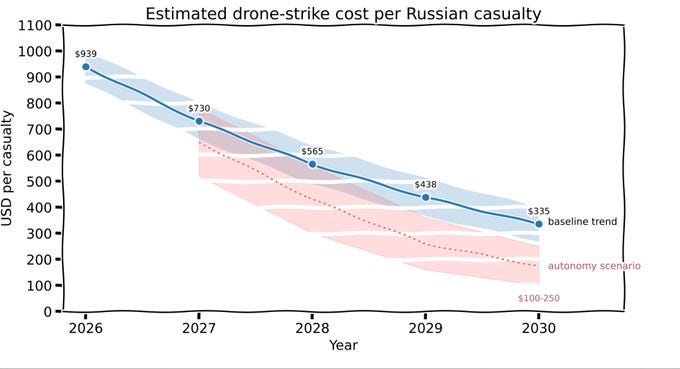
A shift towards systems with a high degree of autonomy, or full autonomy, could reduce the cost significantly, but it does not remove physical or hardware constraints. It might make a move to $100-250 possible, but probably not for long. Autonomy can lower the cost of striking a target, but it will also change the adversary’s behaviour. If the cost of eliminating a soldier in open terrain falls too low, the other side will not simply continue to expose people in the same way, because that exposure has a real cost. At that point, measuring the economics of the war in relation to the number of hit soldiers may cease to make sense. Full, production-grade autonomy could be possible around 2027. Once it is deployed at scale, there is no civilisational way back. The economics of war, and the role of the human soldier inside it, will have changed permanently.